Connect Stack9 to Everything — Push Data Out, Plug Agents In
Webhooks push form submissions to your systems the moment they happen, with queue-based delivery and retries. Instance MCP lets AI agents call your data and automations directly. Two ways in, both built on the permissions you already trust.
Governed Integration, Not a Diagram That Pretends Every System Is the Same
There is no single fixed reference architecture for integration. Different target systems — policy, claims, identity, documents, payments, SAP, data platforms — expose different protocols, so the right pattern depends on what each system actually supports. What is consistent is how Stack9 consolidates and governs them.
One connector interface, any protocol
A Connector registers an external system in a standard, consistent way — REST, a direct database connection, or another protocol as required. Developers work against one interface rather than a different integration approach per system. Already used against policy and claims systems (including FINEOS), identity platforms, document management and generation, correspondence platforms, ERP, CRM, finance and data platforms.
Consolidated through AWS API Gateway
Where possible, multiple external integrations are consolidated behind AWS API Gateway into one or a small number of consumer applications per instance, each then exposed to Stack9 Core as a Connector. However many systems sit behind it, your entities and workflows interact with a governed interface rather than a sprawl of point-to-point integrations.
Decoupling that cuts both ways
When you change, upgrade or replace one of your own systems of record, that change is absorbed at the connector layer — the portal does not need redeveloping, and your system-owning teams do not need to coordinate a synchronised release. Conversely, portal changes do not pull in your system teams unless the integration contract itself changes.
Your back end insulated from portal spikes
Integrations to internal systems can be queued and throttled, so a surge in self-service activity does not arrive at your downstream systems at the same volume. Your systems of record are insulated rather than needing to be scaled to match the portal’s peak.
Proven at real volume
Event-driven processing is a first-class pattern on AWS SQS and EventBridge. A monthly subscription payment cycle at Surf Life Saving Australia generates tens of thousands of queued messages and hours of sustained load, with autoscaling responding to queue depth throughout — and thousands of recurring card transactions monthly, with fail, retry and manual-review handling built in.
Payment data never touches Stack9
Where a payment platform requires a front-end SDK — as most PCI-compliant providers do — the SDK is installed in your Web App Template. Payments are initiated and confirmed in real time through the provider’s own PCI-compliant SDK, and Stack9 never directly handles card data. Deliberately out of scope.
Two Ways to Connect Stack9 to the Rest of Your Stack
Real-time form webhooks
The moment a visitor submits a form, Stack9 POSTs the submission to every webhook registered for that form — no polling the submissions API required.
Queue-based delivery with retries
Deliveries run through a queue with automatic retries, so a receiver's brief outage doesn't cost you a lead.
Secure with custom headers
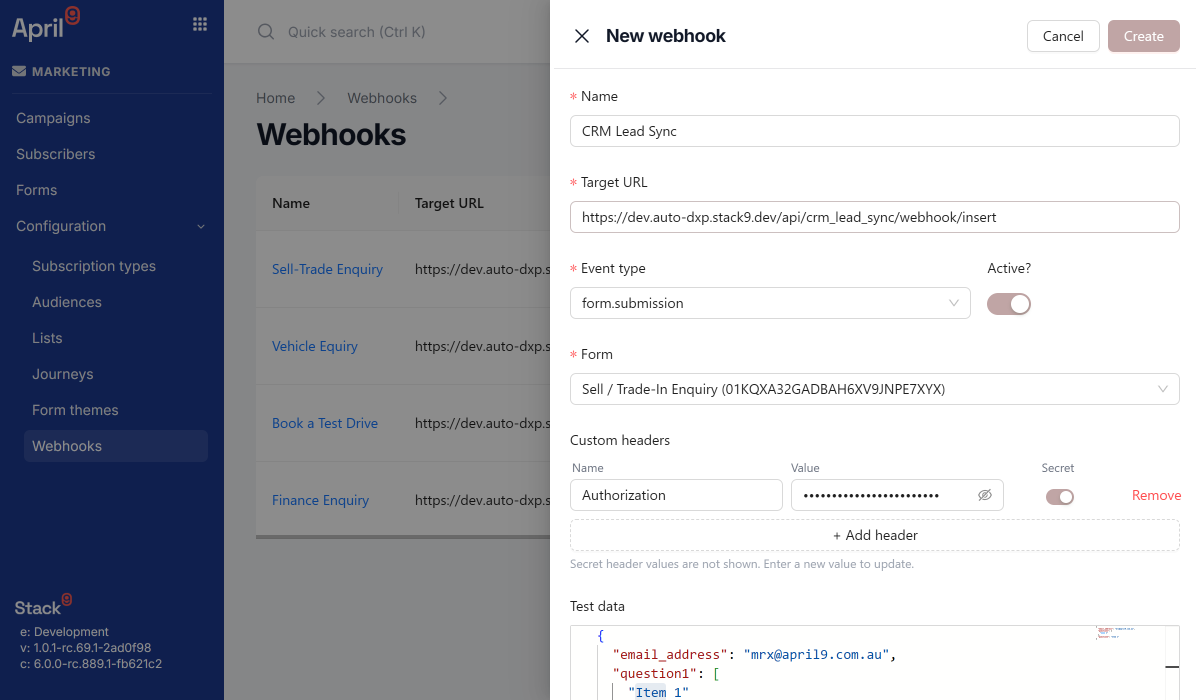
Attach the HTTP headers your receiver needs — API keys, bearer tokens — to authenticate every delivery. Secret header values are encrypted at rest and never echoed back in the API.
Test before you trust it
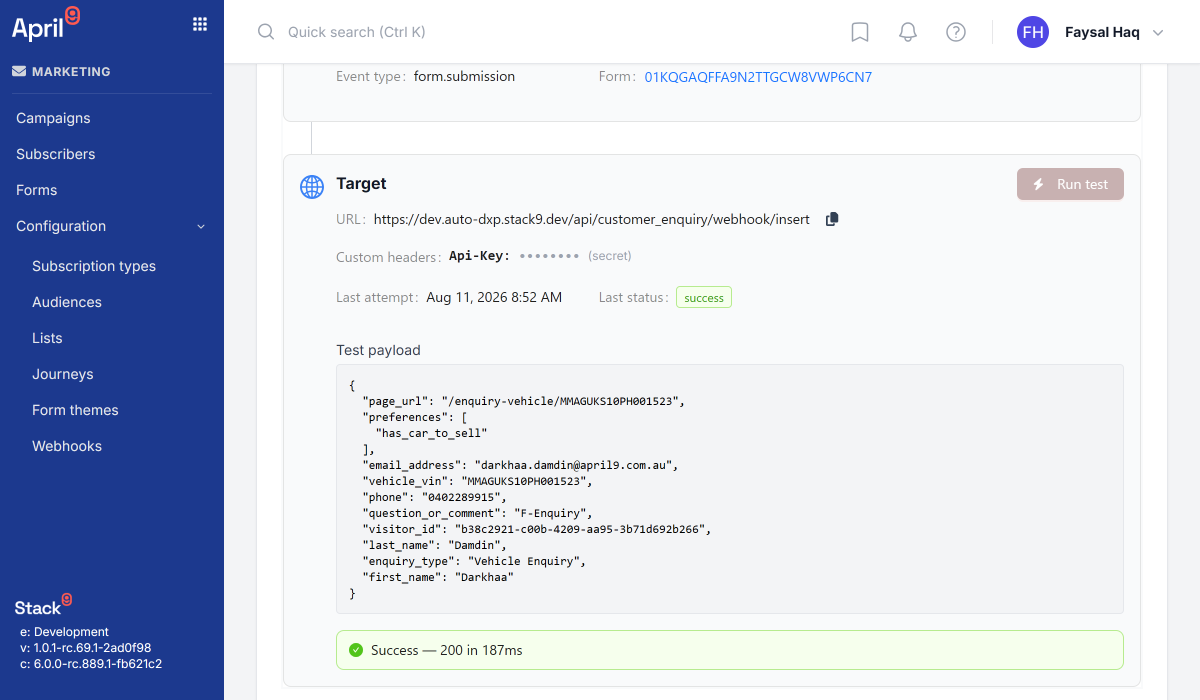
Send a real test payload to your endpoint straight from Stack9 and see the status code, response body, and round-trip time before a single real submission depends on it.
AI agents as a first-class integration
Beyond outbound webhooks, expose your query-library queries and webhook automations as MCP tools so agents like Claude can read your data and trigger actions directly — see Instance MCP.
Form submissions today, built to grow
form.submission is the first event Stack9 delivers over webhooks, registered per form. It's the foundation we're building broader event coverage on top of.
From Form Submission to Your System
Register a webhook
Choose the form to listen to, set a target URL, and add any custom headers your receiver needs to authenticate the call.
Test it
Fire a stored test payload at your endpoint and confirm you get back the status code and response you expect.
Go live
Every submission to that form is queued and delivered to your URL, with automatic retries if the first attempt fails.
Or skip the receiving endpoint entirely
Use Instance MCP to let an AI agent query submissions or trigger automations directly — no webhook receiver required on your side at all.
See the Integration Surfaces
Outbound webhooks for your systems, MCP tools for your AI agents.
Get Data Out — to Systems or to Agents
Register a webhook in minutes, or hand your query library and automations to an AI agent through Instance MCP. Either way, Stack9 enforces the same rules it already does for your REST API.